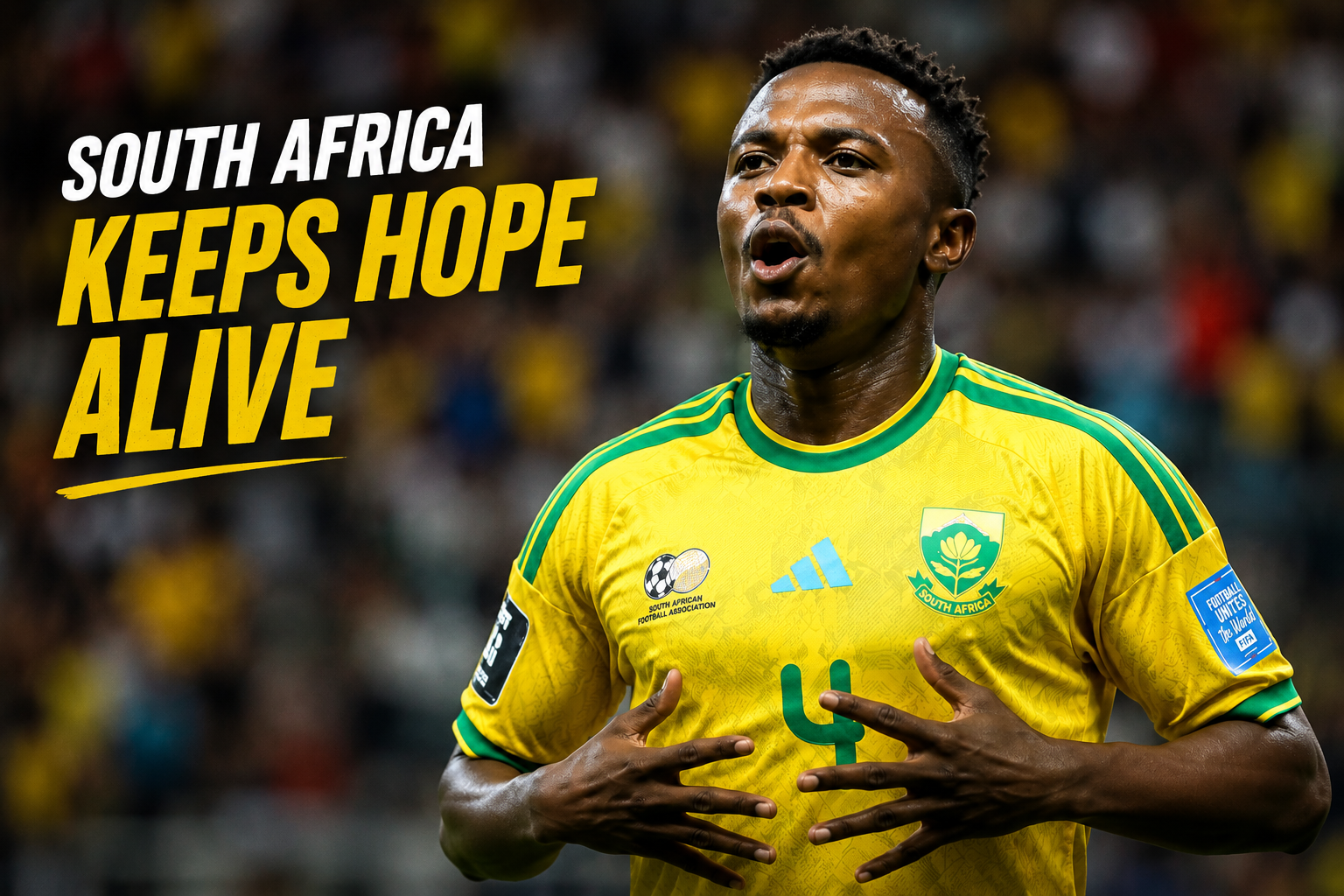
Bafana Bafana refused to let their FIFA World Cup dream fade away as they fought back to earn a hard-fought 1-1 draw against the Czech Republic in Atlanta on Thursday night.
After suffering a disappointing 2-0 defeat to Mexico in their opening Group A encounter, South Africa entered this match knowing that anything less than a positive result would leave their qualification hopes hanging by a thread. The pressure was immense, but Hugo Broos’ side showed resilience, determination and character when it mattered most.
Although the match began in the worst possible fashion for South Africa, they produced a much-improved second-half display and were eventually rewarded with a crucial point that keeps their World Cup campaign alive heading into the final group-stage fixture.
Bafana Bafana vs Czech Republic Starts With Early Setback
The Czech Republic could not have asked for a better start.
Within the opening five minutes, midfielder Michal Sadílek punished poor defensive marking to give the Europeans an early lead. South Africa’s defenders were caught flat-footed, allowing Sadílek enough time and space to finish and put his side in control.
The goal immediately shifted momentum in favour of the Czech Republic, who looked confident in possession and controlled large periods of the opening half.
Bafana struggled to settle into the match and often found themselves chasing shadows as the Europeans moved the ball around comfortably.
Despite their dominance, however, the Czech Republic failed to extend their advantage.
That would eventually prove costly.
Czech Republic Waste Chances To Put The Match Beyond Reach
While South Africa found it difficult to create meaningful opportunities during the first half, the Czech Republic had several chances to increase their lead.
Their movement in midfield caused problems, while their attacking players repeatedly found pockets of space around the South African penalty area.
Fortunately for Bafana Bafana, the finishing lacked precision.
A combination of determined defending and missed opportunities allowed South Africa to remain within touching distance.
At halftime, the score remained 1-0, and despite being second best for much of the opening period, South Africa still had a route back into the contest.
Bafana Bafana vs Czech Republic Changed After Halftime
The second half told a very different story.
Recognising that his side needed more energy and creativity, Hugo Broos made important tactical adjustments.
The introduction of Relebohile Mofokeng and Evidence Makgopa injected life into the South African attack.
Almost immediately, Bafana looked more dangerous.
Mofokeng’s willingness to run at defenders and play progressive passes gave South Africa a new dimension. Instead of sitting deep and absorbing pressure, Bafana began spending longer periods in the opposition half.
The confidence that had been missing in the first half slowly started to return.
For the first time in the match, the Czech Republic found themselves on the back foot.
Mofokeng And Maseko Spark Bafana’s Revival
Much of South Africa’s attacking improvement came through the energy of Relebohile Mofokeng and the pace of Thapelo Maseko.
Maseko consistently stretched the Czech defence with his direct running and ability to carry the ball into dangerous areas. His movement forced defenders to make difficult decisions and opened spaces for teammates.
Meanwhile, Mofokeng provided the creativity that had been lacking earlier in the match.
His introduction transformed the tempo of South Africa’s play and helped create sustained attacking pressure.
The Czech Republic suddenly looked far less comfortable than they had during the opening 45 minutes.
Teboho Mokoena Delivers When Bafana Needed Him Most
As the match entered its closing stages, South Africa’s growing pressure finally paid off.
Bafana were awarded a penalty after a sustained attacking spell inside the Czech penalty area.
With the hopes of an entire nation resting on his shoulders, Teboho Mokoena stepped forward.
The midfielder showed remarkable composure.
He calmly converted from the spot to level the score at 1-1 and spark celebrations among South African supporters.
It was a goal that may prove crucial in determining Bafana Bafana’s World Cup fate.
Not only did it secure a valuable point, but it also rewarded a much-improved second-half performance.
Smarter Tactics Helped South Africa Recover
One of the key differences after the break was South Africa’s willingness to vary their approach.
In the opening stages, Ronwen Williams and his defenders repeatedly attempted short passes while under pressure from Czech attackers.
As the match progressed, Williams mixed things up by launching longer balls forward.
This reduced the pressure on South Africa’s defence and allowed players such as Iqraam Rayners and Oswin Appollis to compete for possession higher up the field.
The tactical adjustment disrupted the Czech pressing structure and helped Bafana gain important territory.
What The Result Means For Group A
The draw leaves South Africa at the bottom of Group A with one point from two matches.
However, the result keeps qualification hopes alive.
A defeat would have effectively ended Bafana’s chances of progressing to the knockout rounds. Instead, they now head into their final group match against South Korea knowing that victory could still open the door to qualification.
The task remains difficult, but it is achievable.
Most importantly, South Africa remain in the fight.
After a poor start against Mexico and an early setback against the Czech Republic, many teams would have folded under pressure.
Bafana Bafana did not.
They showed resilience, responded positively after halftime and earned a point that could yet prove decisive.
The final group-stage match against South Korea now becomes one of the most important games in recent South African football history.

Leave a Reply