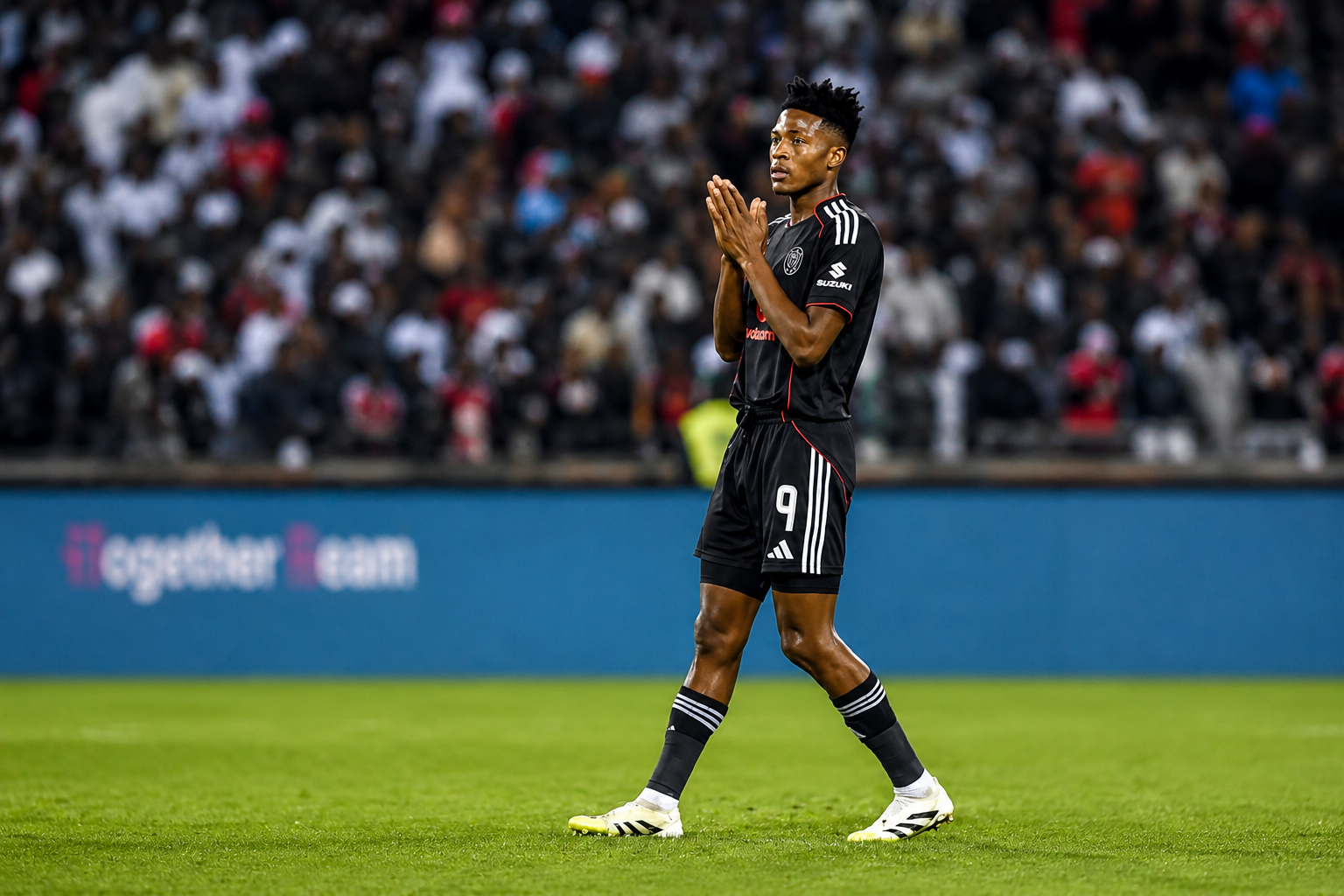
For Yanela Mbuthuma, the second leg against Sekhukhune United was about more than simply helping his team get a result. It was an opportunity to remind supporters why his coach had continued to trust him at a time when confidence in his performances was beginning to fade.
The forward had entered the match under pressure. In previous games, Mbuthuma had found himself at the centre of frustration among sections of the supporters after failing to convert some clear opportunities. The criticism became increasingly noticeable, with some fans questioning whether he should remain in the starting XI.
His coach, however, chose a different path.
Rather than dropping him, the technical team continued to back Mbuthuma. Against Sekhukhune in the second leg, that faith was rewarded with a performance that showed another side of his game. He did not score himself, but he provided two assists in a remarkable two-minute spell that helped change the complexion of the contest.
Mbuthuma makes his influence felt
The first assist arrived around the 37th minute when Mbuthuma helped create the opening goal for Thapelo Mokobodi.
Just two minutes later, he was involved again, this time setting up Gamphani Lungu around the 39th minute.
Two assists in such a short period are significant, but the value of Mbuthuma’s performance goes beyond the numbers.
What stood out was his ability to remain involved in dangerous attacking situations despite the pressure surrounding his own form. A player who has been criticised for missing chances can easily begin playing within himself, taking fewer risks and avoiding situations where another mistake might attract further criticism.
Mbuthuma did the opposite.
He remained willing to participate in the attacking phase, and that willingness produced tangible rewards for his team.
The two assists also demonstrate an important distinction when evaluating a forward. Goals are naturally the easiest contribution to measure, but attacking players can influence matches through movement, combination play, creating space and supplying teammates.
Mbuthuma showed that against Sekhukhune.
A different way of responding to criticism
There is an interesting psychological element to Mbuthuma’s performance.
When supporters become unhappy with a player, every missed opportunity can become magnified. A forward who has already missed chances may begin carrying the weight of those moments into the next match.
That can affect decision-making.
Instead of attacking spaces instinctively, the player may hesitate. Instead of shooting early, he may look for an extra pass. Instead of demanding the ball, he may move away from the action.
Mbuthuma’s performance suggested that he had not allowed the criticism to completely take over his game.
His two assists were evidence of a player still prepared to take responsibility in the final third.
That could prove particularly important going forward.
The tactical value of his contribution
The most interesting aspect of Mbuthuma’s display is that neither of his assists required him to be the player finishing the move.
That is important because it highlights his usefulness as part of a wider attacking structure.
A forward does not always have to be the final action in an attack. His movement can draw defenders away, his positioning can open passing lanes, and his ability to combine with teammates can allow another attacker to become the decisive player.
Against Sekhukhune, Mbuthuma’s contribution demonstrated that he can influence the game without necessarily finding the back of the net himself.
That is particularly valuable for a player trying to rebuild confidence.
Instead of judging his entire performance by whether he scored, there were other indicators that suggested he was contributing to the team’s attacking rhythm.
His statistics were not perfect. Mbuthuma recorded one shot, which was off target, meaning he finished the match with zero shots on target. He was also substituted in the 62nd minute.
On the surface, those numbers might appear modest for an attacking player.
But football cannot always be reduced to shot totals.
Two assists are decisive contributions, and Mbuthuma’s involvement in the goals demonstrated that his influence was not dependent on him being the final shooter.
The coach’s faith may now look justified
Perhaps the biggest winner from Mbuthuma’s performance was also the coach.
Managers are often forced to make difficult decisions when a player’s confidence drops and supporters begin demanding a change.
Dropping the player can sometimes protect the team, but it can also deepen the player’s loss of confidence. Continuing to select him, meanwhile, carries its own risk because every missed chance can intensify the pressure.
The coach chose to stand by Mbuthuma.
Against Sekhukhune, that decision suddenly looks considerably more understandable.
The two assists do not erase his previous missed chances, nor should one strong performance automatically mean that every concern surrounding his form has disappeared.
But it does provide an important response.
Players should be judged over a body of work rather than one difficult spell or one impressive afternoon.
Mbuthuma has now shown that he can contribute meaningfully even when he is not scoring.
Can this win back the supporters?
That may ultimately be the most important question.
Football supporters are demanding because they judge players through moments. A striker can miss three chances and hear criticism for weeks, only to become a hero after scoring the winning goal.
Mbuthuma may now have taken the first step towards repairing that relationship.
His two assists against Sekhukhune give supporters something different to remember. Instead of another game dominated by missed opportunities, they can look back at a player who helped produce two goals in quick succession.
That matters.
Winning back supporters will probably require consistency rather than one standout performance. Mbuthuma will need to show that the creativity and decisiveness displayed against Sekhukhune can become a regular part of his game.
The next challenge is therefore not simply scoring.
It is maintaining the confidence to keep making positive decisions in the final third.
For now, though, Mbuthuma has delivered the kind of response that his coach would have wanted.
He may not have found the net himself. He had just one shot and failed to register a shot on target before being substituted after 62 minutes. But football is ultimately a team sport, and his two assists for Mokobodi and Lungu proved that his contribution can be measured in more ways than goals.
After a period in which some supporters wanted him out of the starting lineup, Mbuthuma has given them a reason to reconsider.
The coach backed him when confidence around the player was falling.
Against Sekhukhune, Mbuthuma repaid that faith with two moments of attacking quality.
Now comes the harder part: doing it again.

Leave a Reply