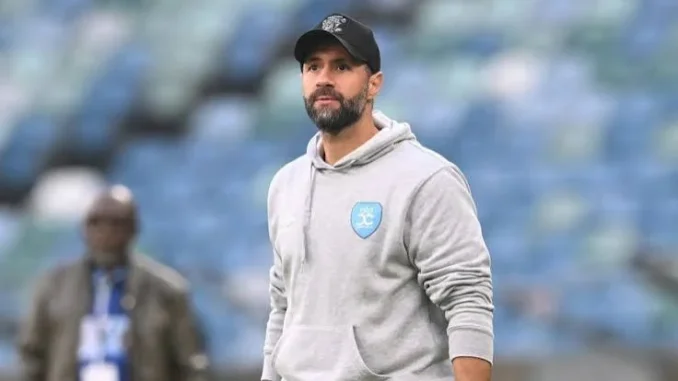
Khalil Ben Youssef has been fired by Durban City after seven league games. See his record, why he was sacked and who could replace him.
Khalil Ben Youssef’s time at Durban City has ended almost as quickly as it began.
The Tunisian coach was appointed in June to lead the club into the 2026/27 season after helping Kaizer Chiefs finish third alongside Cedric Kaze. Durban City expected Ben Youssef to build on a first season back in the top flight that had produced a top-eight finish and the Nedbank Cup.
Three months later, that project is over.
Durban City have parted ways with Ben Youssef after seven Betway Premiership matches, with the team collecting seven points from a possible 21. The record was one win, four draws and two defeats. His final league match was a 1-1 draw against newly promoted Milford FC.
But the numbers alone do not explain why the club made the decision.
There was a clear difference between the football Ben Youssef was trying to introduce and the results Durban City were producing. That tension ultimately became the defining feature of his short spell.
Ben Youssef’s Durban City record
Ben Youssef’s league numbers were:
| Competition | Matches | Wins | Draws | Losses |
|---|---|---|---|---|
| Betway Premiership | 7 | 1 | 4 | 2 |
| CAF Confederation Cup | 2 | 2 | 0 | 0 |
His overall competitive record therefore stood at nine matches, three wins, four draws and two defeats based on the reported results before his dismissal.
The CAF results are particularly important because they show that his tenure was not simply a story of failure.
Durban City defeated Burundi’s Rukinzo FC 3-1 on aggregate, winning 1-0 at home before recording a 2-1 victory away. That took the club through the first preliminary round of the CAF Confederation Cup.
The domestic campaign, however, was where the pressure became difficult to ignore.
The problem was not simply that Durban City were losing
One of the more interesting aspects of Ben Youssef’s short tenure was that Durban City were not necessarily being outplayed every week.
Before his dismissal, Ben Youssef repeatedly spoke about a team that was creating chances but failing to finish them.
After the 0-0 draw against Stellenbosch, the coach said City had dominated large periods of their previous three home league matches and created opportunities without converting them. He specifically identified the final third as the area that needed improvement.
That pattern continued against Orlando Pirates.
City eventually lost 2-0, but Ben Youssef pointed to opportunities that could have changed the match, including one-on-one chances for Lubumba and Gastón Sirino. Durban City were also punished from a set piece when Pirates opened the scoring.
That makes his dismissal more complicated than simply looking at the league table.
The team was producing opportunities. It was not converting enough of them.
And in professional football, the distinction only matters for so long.
What was different about Ben Youssef’s approach?
Ben Youssef was not trying to simply reproduce the football that had taken Durban City to the Nedbank Cup under Pitso Dladla.
He spoke openly about introducing a new philosophy, mentality and mindset.
One of the clearest changes was his willingness to alter systems during matches without wanting the team to lose its identity. Ben Youssef said the players were adapting to changes in formation without struggling, something he viewed as evidence that the tactical work was taking effect.
There was also a strong emphasis on mentality and individual responsibility.
His message to the squad was that players had to work continuously, improve themselves and set ambitions for their own careers. He also wanted the group to approach opponents without the mentality that certain teams were automatically bigger or smaller than them.
That was a different emphasis from simply protecting results.
Ben Youssef wanted Durban City to become a team capable of controlling matches, creating chances and changing tactical systems according to the situation.
The problem was that the scoreboard was not consistently rewarding that approach.
Durban City were creating chances — but the finishing became the issue
This was perhaps the biggest contradiction of Ben Youssef’s tenure.
The club’s own reporting acknowledged that City were creating opportunities while struggling to score. Ben Youssef himself highlighted missed one-on-one opportunities and open goals. Vodacom Soccer reported that City ranked among the top three teams in the league for both chances created and chances conceded at that stage, while finishing remained a major problem.
That suggests there were two different stories happening at the same time.
The tactical story: Durban City were generating opportunities and showing enough flexibility to compete.
The results story: They were winning only one of their first seven league matches.
For a coach, eventually the second story becomes the one the board has to respond to.
The final trigger appears to have been the 1-1 draw with Milford, after which the club decided to make the change.
The timing makes the decision particularly significant
Durban City had only just begun their CAF Confederation Cup journey.
They had already eliminated Rukinzo and were preparing for the next stage of the competition when the club decided to remove the coach.
That means the board was effectively choosing to change direction while the team was still alive in continental competition.
It also means the decision was primarily driven by the domestic league return rather than the club’s overall competitive record.
That distinction matters.
Ben Youssef did not leave Durban City after a disastrous run across every competition. He left after a domestic campaign that produced too many draws and too few wins, despite progress in the CAF competition.
The Kaizer Chiefs connection
There is also an interesting link to Ben Youssef’s previous job, although it should not overshadow the Durban City story.
Ben Youssef and Cedric Kaze were both part of the Kaizer Chiefs technical setup. After Nasreddine Nabi’s departure, the pair stepped up to share responsibility for the senior team.
Chiefs later confirmed that both coaches left when their contracts ended. During the 2025/26 campaign, they oversaw 39 matches, recording 19 wins, 11 draws and nine defeats, while Chiefs finished third in the league with 54 points.
Kaze subsequently became head coach of Sekhukhune United, while Ben Youssef moved to Durban City. The two even faced each other as head coaches in the opening weekend of the 2026/27 campaign.
Now both former Chiefs co-coaches have lost their jobs at their new clubs within the opening part of the season.
That is an interesting subplot, but Ben Youssef’s Durban City record remains the central reason for his departure.
Was firing Ben Youssef the right move?
The evidence gives Durban City a clear reason for making the change: seven points from seven league matches was not the start the club wanted after its previous season’s success.
But there is another side to the decision.
The coach had been in the job for only around three months. His team had progressed in the CAF Confederation Cup, was creating chances and was still adapting to a new tactical approach.
That makes the decision less about whether Ben Youssef had completely failed and more about how much time Durban City were prepared to give the new project before demanding immediate league results.
The club has already shown a willingness to change coaches quickly. Since returning to the top flight, Durban City have gone through Sinethemba Badela, Gavin Hunt and Pitso Dladla before Ben Youssef. Dladla had delivered a top-eight finish and the Nedbank Cup before leaving for Golden Arrows.
The next appointment therefore matters for more than just replacing Ben Youssef.
It will determine whether Durban City are building a consistent football project or continuing to reset their technical direction whenever results slow down.
Who steps up next at Durban City?
For now, the most concrete name being reported is Ernst Middendorp.
The Star reports that Durban City are considering Middendorp for another spell at the club after he previously worked there as technical director. The report says Musa Nyatama could potentially remain involved as an interim option, but there is a complication because of his coaching licence for the upcoming CAF fixture.
Middendorp would represent a very different proposition from Ben Youssef.
Ben Youssef arrived with the task of developing a new philosophy and had spoken extensively about tactical flexibility, mentality and creating chances. Middendorp is a much more experienced South African top-flight coach and already knows the Durban City environment.
But whether the club ultimately chooses him or someone else remains to be confirmed.
Durban City now have a bigger question than simply replacing the coach
The immediate issue is finding someone to take charge.
The bigger issue is deciding what Durban City actually want their next coach to build.
Ben Youssef was appointed with the language of long-term stability and a new phase for the club. (Durban City FC) Three months later, that plan has ended.
The next coach will inherit a team still competing in the CAF Confederation Cup, a squad capable of creating opportunities and a club coming off a Nedbank Cup triumph.
But they will also inherit the problem that ended Ben Youssef’s tenure: Durban City need those chances to become league victories.
That is ultimately what Ben Youssef could not deliver quickly enough.
And with the club already changing coaches several times since returning to the Premiership, the next appointment will be watched not only for the results it produces, but for whether Durban City can finally establish a technical direction that lasts longer than a few months.

Leave a Reply