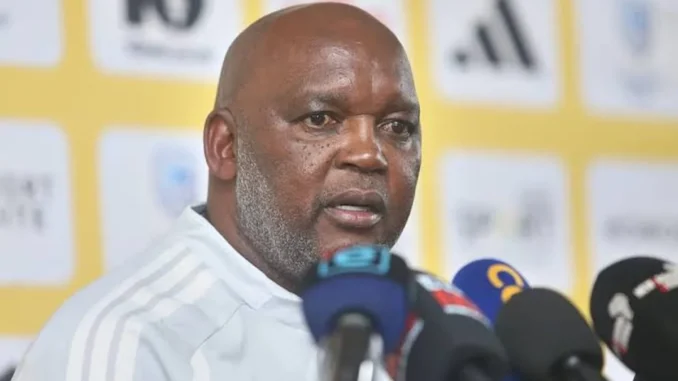
Pitso Mosimane sparks debate after telling Oswin Appollis to adapt his Orlando Pirates playing style to Bafana Bafana’s tactics.
Pitso Mosimane’s tactical instructions to Oswin Appollis have sparked debate among South African football supporters, raising important questions about club loyalty, national team responsibilities and how players should adapt when representing Bafana Bafana.
The Bafana Bafana coach made his position clear after South Africa’s 2–1 victory over Guinea in their opening 2027 Africa Cup of Nations qualifying match at Orlando Amstel Arena on 26 September 2026. His comments focused on how Appollis operates at Orlando Pirates compared with the responsibilities assigned to him in the national team.
While some supporters understand Mosimane’s reasoning, others have questioned whether his tactical preferences give certain club players an advantage. The discussion has become another example of how South African football’s club rivalries can influence conversations about the national team.
What Did Pitso Mosimane Say About Oswin Appollis?
Mosimane explained that Appollis must adjust his positioning when playing alongside Aubrey Modiba, particularly because Modiba has different responsibilities in Bafana Bafana’s attacking system.
According to reporting by Daily News and Afrik-Foot, Mosimane said Appollis normally moves inside at Orlando Pirates, where Deon Hotto provides width through overlapping runs. However, the national team’s tactical arrangement requires Appollis to remain wider when Modiba moves into central areas.
Mosimane’s explanation was straightforward: Appollis cannot simply reproduce his club responsibilities without considering how his teammates operate around him.
The coach also indicated that Kamogelo Sebelebele sometimes needs to remain deeper rather than advancing, depending on the team’s attacking structure.
These instructions illustrate Mosimane’s emphasis on positional discipline, with each player expected to understand how individual movements affect the overall team.
Why the Orlando Pirates and Sundowns Comparison Matters
The controversy is particularly interesting because Appollis represents Orlando Pirates, while Modiba has established himself at Mamelodi Sundowns.
Both clubs have distinct tactical approaches, and their supporters naturally take an interest in how their players are used in the national team.
At Pirates, Appollis has opportunities to move into central spaces, combine with teammates and threaten opposition defences through his movement. In Mosimane’s Bafana setup, however, the winger is being asked to occupy wider positions to create space for Modiba’s movement.
This difference does not automatically mean one club’s football philosophy is superior to another’s. Instead, it highlights how the same player can perform different responsibilities depending on the coach, formation and teammates.
For national team football, the challenge is particularly important because coaches have limited preparation time compared with club managers.
Players arrive from different clubs, having trained under different systems. The national coach must bring those individuals together and establish a structure that works collectively.
Why Some Fans Are Divided Over Mosimane’s Instructions
The debate surrounding Mosimane’s comments reflects the strong club identities within South African football.
Some supporters may interpret the tactical explanation as evidence that the coach is prioritising a system familiar to Sundowns players. Others see it as a normal coaching decision based on the specific qualities of the players available.
However, the distinction between tactical preference and club favouritism is important.
A coach choosing to use Modiba in a particular role does not, by itself, establish that Orlando Pirates players are being treated unfairly. Equally, supporters are entitled to question whether a particular system makes the best use of the national team’s available attacking talent.
The relevant question is whether the chosen arrangement produces balance, creates opportunities and allows players to contribute effectively.
There is also a danger in turning every tactical disagreement into a Pirates-versus-Sundowns argument. Bafana Bafana represents South Africa as a whole, and its results involve players from several clubs and backgrounds.
The national team’s performance should therefore be examined through its collective execution rather than the identity of individual players’ employers.
What Appollis Must Change in Bafana Bafana
For Appollis, the challenge is understanding when to maintain width and when to move into central positions.
Remaining wide can stretch an opposing defence, create space between defenders and provide an outlet when Bafana Bafana regain possession. It can also give Modiba room to move inside and participate in midfield combinations.
However, staying wide throughout a match would not necessarily be effective. Football is dynamic, and opportunities to move inside may emerge depending on the opposition’s defensive shape.
The important requirement is coordination.
If Appollis moves inside while Modiba also occupies the same space, Bafana could become congested in central areas. If both players remain wide, the team might lack sufficient presence between the opposition’s defensive lines.
Mosimane’s instructions appear designed to manage these positional relationships rather than restrict Appollis’s creativity.
The winger’s ability to recognise when to follow instructions and when to exploit an opportunity could become an important aspect of his development at international level.
What the Guinea Match Revealed About Bafana’s Tactical Transition
South Africa’s 2–1 victory over Guinea provided Mosimane with a positive start to his second stint as national team coach, although the performance also highlighted areas requiring improvement.
Bafana secured the result through goals from Ime Okon and Samukele Kabini, while Guinea’s equaliser demonstrated the challenges the team faced during the match. Contemporary reporting also noted that Appollis struggled to make a decisive attacking impact, while the team’s defensive organisation remained a work in progress.
These observations provide context for Mosimane’s tactical comments.
A national team cannot depend solely on individual attacking ability. Wingers, fullbacks and midfielders must understand their responsibilities when possession changes hands, particularly against opponents capable of exploiting open spaces.
For Appollis, this means contributing defensively when required while remaining available to support Bafana’s attacking transitions.
For Mosimane, it means finding a system that accommodates different players without compromising the team’s balance.
The opening qualifier offered useful information, but one match is not enough to determine whether the new tactical approach will consistently deliver results.
Related Articles You Can Also Read:Paulo Duarte questions AFCON 2027 qualifying format after Guinea’s defeat to Bafana
What Happens Next for Appollis and Bafana Bafana?
Bafana Bafana’s upcoming fixtures will provide further opportunities to assess how quickly the squad adapts to Mosimane’s instructions.
The coach will need to evaluate combinations, player positioning and defensive responsibilities while preparing for competitive matches.
Appollis will remain an important attacking option, but his role may change depending on the opposition, available teammates and tactical requirements.
The same applies to Modiba and Sebelebele, whose responsibilities will depend on how Mosimane wants the team to build attacks and protect its defensive areas.
Ultimately, the discussion is about more than one Orlando Pirates player being asked to change his positioning. It concerns the balance between individual strengths and collective organisation in international football.
Final Thoughts
Pitso Mosimane’s comments have opened an important conversation about how Bafana Bafana should combine players from South Africa’s leading clubs.
His instructions to Appollis reflect a tactical requirement, while the criticism and debate among supporters demonstrate the passion surrounding national team selection and club rivalries.
Whether the approach proves effective will depend on performances over the coming matches, not simply on the coach’s explanation.
For Appollis, the opportunity is to demonstrate that he can adapt without losing the qualities that make him valuable. For Bafana Bafana, the objective remains building a coordinated team capable of competing consistently at continental and international level.
The coming fixtures will reveal whether Mosimane’s tactical adjustments can translate into sustained improvement.
EDITORIAL NOTE: This article is an independent football analysis based on published match reporting and the coach’s reported comments. It does not claim to represent an official statement from SAFA or Orlando Pirates.

Leave a Reply